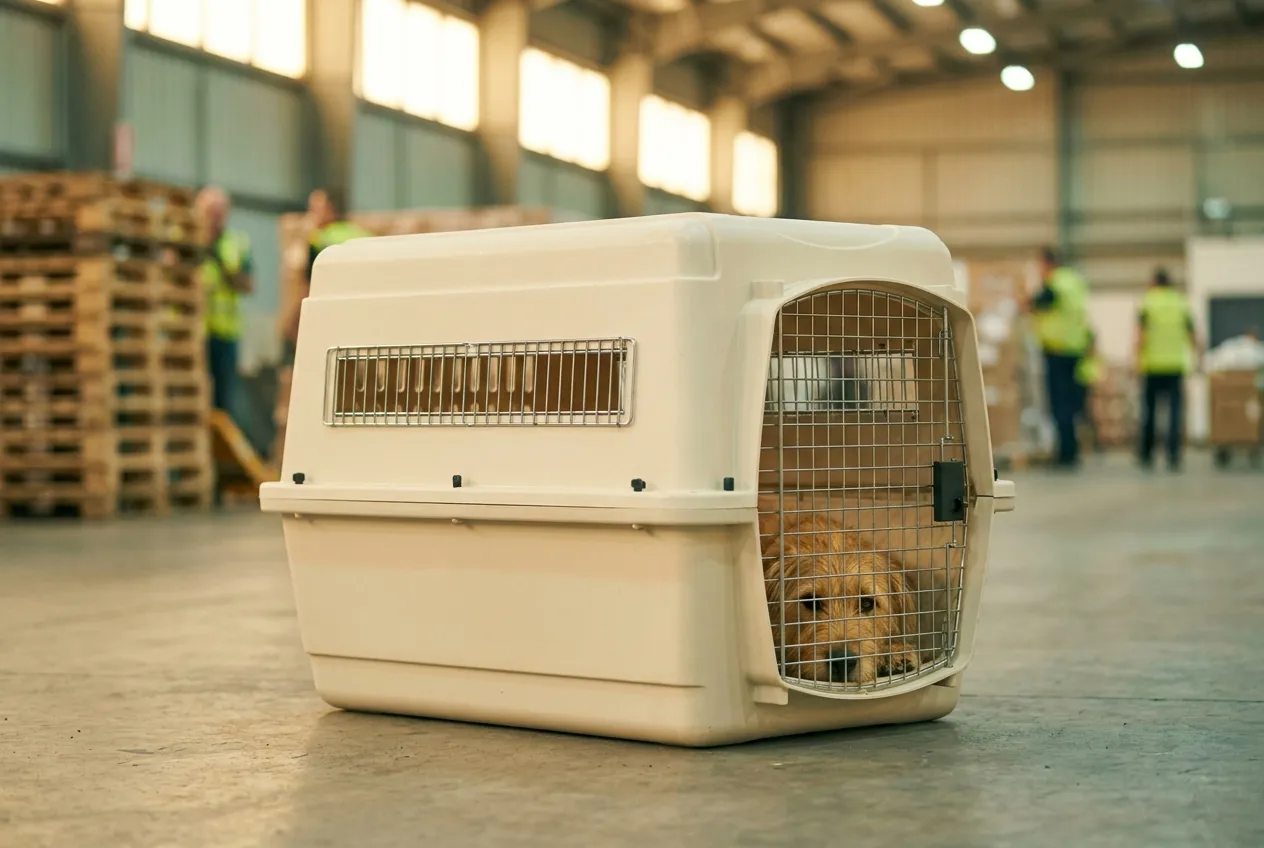
What the standard actually is
IATA publishes the Live Animals Regulations, and Container Requirement 1 is the section that covers dogs and cats. It describes a rigid enclosure — moulded plastic, fibreglass or wood — with a solid roof, a leak-proof floor and a door that cannot be pushed open. Airlines adopt the standard as a minimum and then add their own conditions on top, so a crate can be IATA-compliant and still be refused by a particular carrier. Treat the regulation as the floor and the airline’s written spec as the real requirement.
Measuring your animal
Four measurements decide the size. A is nose tip to the base of the tail, B is ground to elbow joint, C is the width across the shoulders, and D is the height from the ground to the top of the head or the ear tips, whichever is higher. Interior length must be at least A plus half of B, interior width at least twice C, and interior height at least D. The final check is behavioural rather than numeric: the animal must be able to stand without touching the roof, turn around fully and lie down in a natural position.
Ventilation, bolts and hardware
International crates generally need ventilation openings on all four sides, with a substantial share of the total opening area on the upper half. The two halves must be joined with metal nuts and bolts around the full perimeter; the plastic snap clips supplied with many retail kennels are the most common reason a crate is rejected at the counter. Doors should be metal, with a spring-loaded or centrally locking latch that engages the frame above and below. Wheels have to be removed or immobilised, and external spacer bars keep the ventilation clear when the crate is loaded beside freight.
Fitting it out for the flight
Attach food and water dishes inside the door so they can be filled from outside without opening the crate, and tape a small bag of food to the top. Line the floor with absorbent bedding — a puppy pad under a blanket works; straw and hay are refused by many countries on biosecurity grounds. Mark the crate with "Live Animals" labels and upright arrows on at least two sides, and add a card with your name, phone numbers, the animal’s name and feeding instructions. Do not add a padlock; handlers may need to open the door in an emergency.
Acclimatise weeks in advance
Buy the crate early and leave it open at home with familiar bedding inside, so it becomes a normal place to rest rather than something that only appears on travel day. Feed meals in it, then start closing the door for short periods and gradually extend them. Practise a car journey in the crate if the animal will travel to the airport in it. An animal that already sleeps in its crate handles check-in, loading and a long hold flight far better than one meeting it for the first time at the terminal.